The Utopia Workshop Ltd
Adult Community Education and Arts
directed by Robin Sivapalan, an adult education organiser based in London

The Utopia Workshop's programme for educators and leaders in any field living in Kingsbury and the surrounding areas of northwest London.
March - October 2027
£420 minimum fee
Groupwork: in literature, philosophy, history, psychoanalysis, theatre & education, with a special focus on France.
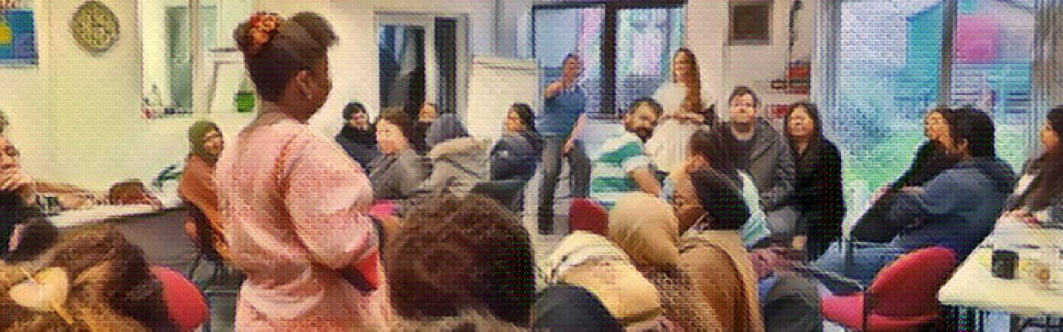
The programme involves 6 months intense exploratory reading and discussion, working through three (of twenty) curated reading lists concurrently in well-facilitated, self-managed groups; 2 months collectively producing a play in conjunction with public educational workshops.
An affordable way for passionate local educators to belong to an advanced dialogic learning community in the humanities.
"One of the most wicked destructive forces, psychologically speaking, is unused creative power. If someone has a creative gift and out of laziness, or for some other reason, doesn't use it, the psychic energy turns to sheer poison. That's why we often diagnose neuroses and psychotic diseases as not-lived higher possibilities." -Marie-Louise von Franz’s book Shadow and Evil in Fairy Tales
Sous les feux d'artifice
the clair-obscur of Europe's lost library, gathering

1. C18 Enlightenment: the long century casting its even longer shadow
A pivotal century of emulation and revolution in scientific and religious thought, literary expression, and social, economic and industrial organisation. Europe, in the name of Reason, enlarges its envergure across the world's surface and the interior terrain of the human mind. A constantly re-written chapter defined by the political rivalry - and intellectual symbiosis - of Britain and France. Infant America, fed by both, decides to break free. Across Europe, from faculty to faculty, the century differs in its beginnings and endings; it is altogether more studied in France despite Britain's clear political victory by 1815. It's the era where the Republic of Letters courts the Enlightened despots, in music it's bookended by Handel-Bach and Mozart-Haydn. The academy shifts to the centre of the emerging modern state and the foundations are laid for the near-universal literacy achieved the following century. Locke's writings re-weaponises the old blank slate concept to challenge the notion of "innate ideas", implanted by God, the flimsy prop of the Divine Right of Kings to rule. A vision of universal potential crystallises, education is enthroned as arbiter of right. The novel is born, populariser of subjectivity and adventure. Subscription-based libraries spring up; at coffee-houses people in-gather to spread ideas, to rally.

2. 'Utopian Thought in The Western World': a folie à deux festschrift to fantasy
Standing strong, still, today at 912 large luminous pages, 'Utopian Thought in The Western World' was the magnus opus of Frank E. Manuel, historian and philologist, co-written with his wife Fritzie over a quarter of a century, published in 1980, winning several prestigious awards. It features exhilarating psychological portraits of utopian thinkers and weaves an astounding tapestry of Utopian ideas from the renaissance to the 20th century, with their Greek and Biblical wellsprings. Their writing is replete with personality; the variety of approaches taken for each major figure, period or theme has an overarching intelligence that makes their subjective choices and their especial homages intrinsic to the delight of their whole edifice. Turgot & Condorcet form an organic unity; Leibniz, Rousseau and Kant receive the global treatment their minds deserve; the English Civil War and the milieu that produced Erasmus, More & Rabelais come to life as two atmospheres of ideas; Fourier emerges as their clear pet Utopian. The book is critical celebration of the persistence of the obsessive-utopian propensity in humankind; a tour de force where educational concerns are the centre of the manifestoes; erudition manifest in the glory of their book..

3. Go tell it on the mountain:
God's verbs, the nation's Biblia, and the endless exegesis
The most widely distributed book in the world, translated into 6-10 times as many languages as its nearest rival (Le Petit Prince), the enigmatic main character God - Ehyeh Asher Ehyeh - displays a dubious, but always compelling, range of personality traits / mood disorders. He demanding adulation and awe from an immense supporting cast of actors, mere mirrors, off-shoots of a creation he always was gnarly about. Then Jesus, inscribed in the Greek. A centuries' old education in the intricacies of translation, interpretation and application, with real world and literary ramifications - it's a must read before you give up the ghost. Truly, believe it or not, against the thinness of the street corner pamphleeter, the boredom of the Sunday sermon, the picayune platitudes of promise that Jesus loves you, there's gravitas, there's poetry (alongside pedantry) and passion.

4. Soul-analysis: Freud and friends and their epigones, on the fence.
From the performative hysteria at the Pitié-Salpêtrière Hospital in Paris, studying under Charcot, to the intimacy of his consulting room-cum-womb-tomb, Freud's staking out of the field of psychoanalysis - and the talking cure - is surely the greatest, most curious achievement of the C20. A psychological drama itself as fledgling movement, Freud's tight steer over practice, publication - and excommunication - to determine the destiny of the field also reflected the (ongoing) contest between medical and philosophic approaches to the mapping the human psyche. His was an effort, painstakingly justified in his writings, to straddle the two. A trained neurologist he wanted his method to have the rigour of the natural sciences, but acknowledged his practice as an the art of interpretation, noting that his case studies read like novellas. "Everywhere I go, I find a poet has been there before me." The encyclopaedic scope of his writings - a circle of learning - has won him devotees among eminent historians and literary critics who borrow these tools to make the past and the text speak the unspoken, more than they knew they were saying. Casting a light on so many aspects of human experience, he stalks almost every room in the next section's courses, clipboard and pen in hand.

Monumental Marx, his musketeers and the Many: reaping the full fruits of our global force of labour
"Je ne suis pas un marxiste.", said Marx. Like Hamlet, the tragedy was that he knew would never be understood, try as he might. He was relentlessly coruscating in the corrections he issued - that barb was to his own son-in-law, Paul Lafargue, chief among the phrase-mongering French, where Marx saw his method of analysis being turned (already!) in to a form of dogmatism. It took Marx some twenty years to produce his masterwork Das Kapital, from the initial research, though his 800-page Grundrisse foundational notebooks, to the "finished" text, that is, of Volume 1. With self aware irony, he referenced Balzac's story 'The Masterpiece' as he finally handed over the manuscript to Engels for the publishers, wherein the painter's constant reworking of his chef d'oeuvre obliterates it to all but his own eyes. With the maximalist's obsessiveness, Marx grappled with all available knowledge in the tradition of the universalist polymath, famously crediting England for its political-economy, Germany for its philosophy, France for its utopian socialism. His method could be called dialectical - or historical - materialism, and he is reluctantly included among the pantheon of western historians: that class struggle a motive force in human history is a point of analytic departure none since can ignore. The short, sharp bullet of the Communist Manifesto is the most widely translated political text of all time. Almost of third of the world's population in 1980 lived under states claiming to be Marxist-Leninist. The place that Marx and the early Marxists earn on this course, is not just due to political legacy. They were deeply cultured people: Marx was a huge fan of Cervantes, Diderot and Sterne (who you'll see grouped together in the next section of courses) and even tried to emulate Sterne's style. He loved Shakespeare and Goethe, and saw his writing to be his life-work, an artist's labour. This literary predilection, the concern with cultural issues, characterises the generation that followed, but it divided between the academy and the party today. Oh, and his pedagogic stance: "The emancipation of the working class must be the task of the working class itself."

1922: Wandering Jews, Mourning, Melancholia, Penelope's Work & the Epic
'The Remembrance of Things Past': C.K. Scott Moncrieff's English translation was almost as lengthy a labour of love as Marcel Proust's original writing, fellow gays in the closet. Proust was a contemporary and rival of Joyce - a span of decades vs that of a day, duchesses vs chambermaids. In the same letter, September ‘22, Virginia Woolf said of Proust: "How at last, has someone solidified what has always escaped—and made it into this beautiful and perfectly enduring substance?" but of Ulysses that "Genius it has, I admit; but of the inferior water" Yet her diary concedes four days later that "what I am doing is probably being better done by Mr. Joyce" and elsewhere that "he is concerned at all costs to reveal the flickerings of that innermost flame." And so in 1922, when Proust died, when Ulyssees was published (in Paris) and Jacob's Room, and T.S Eliot’s ‘The Waste Land’, there's poor Walter Benjamin. He announced but failed to launch Angelus Novus, a journal of literary criticism; he too undertook the labour of translating Proust, the first to appear in German, though the manuscript Sodome et Gomorrhe was lost or destroyed during his flight from the Nazis. "I must say that I am poisoned by it, and yet I also find in it a very significant schooling for my own work." And lastly, all four looked back to Homer; the first edition of Ulysses bound in "Aegean Blue" while adopting the theory that Homer was of Semitic stock, hence casting Leopold Bloom as a Jew. Woolf (married to a Jew but somewhat antisemitic) on the Greeks: " it is the solidity of their sorrow that strikes us. ... "It is a sorrow that has been clarified; it is not, as with us [moderns] mixed with a thousand other things"... ] Freud 1917 (via Riviere in English in 1924) "In mourning it is the world which has become poor and empty; in melancholia it is the ego itself."
founders, foundations

1. Ain't I A Woman?
Divine, Profane, Surgical, Published: The Performing & non-performing Wombs & Brains of our Doras & Noras
Women were somewhat missing, but where did they fit, how should they feature. Mother-daughter rivalries? As the oppressed - and the exploration of the roots of their oppression? As empowered - mythically, subliminally, materially - in what domain? As writers, activists, educators, healers? The starting point that felt most congruent was along the patient-healer axis, and from there, everything else crept and fought back in. From the Witches, Midwives Nurses, to the Bell Jar and the Yellow Wallpaper, a host of women writers have had a say, alongside a few male allies and some exemplars of provocation and domination. Luce Irigiray was one of the first voices to preponderate, emerging as a complex answer to the question that posed itself when comparing the lot of women in France with their philosophies and that of women in the Anglo-Saxon world with their political sociologies. The latter somewhat poorly represented in the collection of texts but there's Federici's Caliban and the Witch and her erstwhile fellow-traveller from the Wages for Housewives era, Selma James. Whether the woman's role in question is as educators, wives, workers, carers, mothers, activists and healers; whether the input is literary, philosophical or political; whether the women in view are considered active, passive, rebelling or complicit: a central antagonism is present throughout: the female subject and subjectivity is formed by, lives with/under the law of the father. And in among the analysis of material conditions and the strategies to change material reality, there is adamant persistence, an undoubtedly feminist one to go there on the question of specifically female interiority. The questions facing women, their doubts, their strivings are also to be found, centrally, in courses 2,3 & 5.

2. I can't get you out of my head / from under my skin. Perch to perch, prop to prop, The Double lives of the haunted ego (in search of the other).
Split off, appropriately enough, from the course 3, the question of the Double posed itself. Dostoevsky's case study, Jekyll and Hyde, The Picture of Dorian Gray... Wuthering Heights. What is it that's going on? Does the Double represent a crisis of the self, or is it no more than a tale of the uncanny? In our own searches for the other, it's now a commonplace assertion that we merely find reflections of our self (or do we call it projections, shadows, alter egos?). R.D Laing raises his hand to say, its a split, a confrontation between our true selves forced into hiding vs the false ones, compliant masks we opted for, insecure in our own existence. Alice Miller might interject: the split in the child is to please the parents. On the question of our peer-peer relations, Melanie Klein's might assert that rivalrous envy is the motive force, the imprint of the siblings, or indeed that guilt binds us to the other, as in Stefan Zweig's Beware of Pity. The big brother that torments us may be a whole continent, as in Kafka's America. Otto Rank, developping the old idea that shadows and reflections were souls, and their loss represented death, describe a primary narcissism, an aspect of which is fear of death; the Double is created as an insurance, a protection from death - and act of love. But if as the person matures, they stay stuck in narcissism, the double comes to represent everything they can't control, becomes malign, an omen of death. Jean Laplanche, a serious re-interpreter of Freud's work, would turn the spotlight on the process whereby the child creates the boundary of the ego, a stable 'I' as a means of psychic survival: translating, organising, ordering - incorporating - what it can from the barrage of enigmatic messages they receive from the adults (themselves, it should be said, not fully conscious of what they transmit). But it's always an inadequate process, there's always a residue of untranslated, unincorporated nut nonetheless messages-experiences, symbolised by castration, a symbol of lack. We're left with this feeling, like a splinter under the skin, and we go forward in life attempting, to complete a translation which can never be adequate. The Jungian, waited too politely to speak, but they're here to, having 1-2 with as many texts as they can collar, offering to transmute to double into a source of creativity. Artaud lights a fuse,

3. The Voices Told me To /Moi, j'accuse - The Contest of the absolute authorities.
A trio of plays: Anouilh's 'Antigone', Osborne's Luther and then Shakespeare's Richard II. Antigone's obstinate fidelity to her moral system comes up against the necessary cruelty of Creon standing in for the state; Osborne's portrayal of Luther as a figure similarly hunted, the intensity of his self-inflicted trials sets the trajectory for his confrontation with the church hierarchy. Both characters eventually obey a higher reason, internalised, but not without inner turmoil that precedes the outward battle. Richard II, facing the fait-accompli of his usurper is more resigned in his defeat, as though once the mirror of his counterparts and the court fails to reflect his Divine sovereignty, he crumbles. "Ay, No; No, Ay". But not entirely. His commitment to the role, his theatricality in refusing to make a public confession, his smashing the mirror, logically, commits him to the prison cell at best, not the retreat to a hermitage he was offered earlier.
The protagonists of the other texts on this course navigate their selfhood set against the potency of the bureaucracy, the psychiatric institution, the courtroom. Whatever the setting, a trial is at stake, and the subject the choice is to perform madness or martyrdom; the trial was convoked from the very moment they would obey the voice in their head.
With analytic rescue from eminent French Freudian Janine Chasseguet-Smirgel on the Ego Ideal (who they feel they must be), Heidegger, Kierkegaard, Alice Miller, Foucault (naturally), Ranciere and others: there's no in camera courtroom. The trial is staged, the plea and the judgement, the audience-public, are together complicit in the agony of the individual.

5. Sublimations: Golden Notebooks in the Garden on Gethsemane
Agon - contest, competition, struggle - was a daemon or a minor deity in the Greek world, often linked to Zelos (rivalry) and Nike (victory) - symbolising the necessary human struggle to achieve success. Virtue & excellence - arrete - is achieved through agon, endurance, the active process. The contest is there in role protagonist and antagonist. It becomes a term in intellectual debate, also associated with the courtroom. We can think of the adversary (Satan) who incites God to let him really test Job's piety through a trial of tragedy; or the Devil's Advocate, the official in the Catholic Church who acted like a prosecutor in process of canonisation, trying to find reasons deny a candidate their sainthood; J.S. Mill , 'On Liberty' about our beliefs needing to be subjected to the strongest possible criticism; or Marx to encourage the French working class to wade in the water of Capital:There is no royal road to science, and only those who do not dread the fatiguing climb of its steep paths have a chance of gaining its luminous summits."; and to bring us up to date, Robert Howell, imagining the crippling effect a Google Morals Map that guides right conduct would represent: "Virtue is not a piece of information that can be handed over; it is a way of being that must be achieved." All this to say that there's no material or spiritual bypass to sublimation.
A Freudian term where it's generally taken to represents the redirection of libido, recast by Laplanche, in his lectures on Sublimation as the struggle to retranslate the traumatic energy that hasn't been understood. For Freud, the sexual energy is desexualised and "bound" to a new, cultural object, or work; the sexual nature remains for Laplanche - and keeps its obsessive character - but not as a trauma repeated by a truth represented, in symbolic form. For Jung the battle between the ego and the shadow (the conscious and unconscious) through the mechanism of the "transcendent function" moves us along the process of integration, individuation. Lacan has his axe to grind to on the matter, and he gets to speak in his own book, but our contemporary Jamieson Webster walks us from Freud through Lacan should you wish to eave him on the shelf. And one more thing, we have Christ's Agony in the Garden, but the whole process from entering Jerusalem to the resurrection, and while agony remains as a word in Latin, it maps only onto the death throes, while passio- passive endurance - becomes the catch-all word encompassing the emotions. And in the line up of literary giants - Lessing, Kazantzakis, Woolf, Sackville-West, Murdoch, Duras, Stendhal, Goethe Dostoyevsky, Flaubert, Hesse -you'll see their characters flex, making a direct bid for sublimation. Some fail, some get there or close, if you think that's possible. Adorno didn't. Glorious nonetheless.

4
Stories within stories, folies à deux, the head and the belly, the high-flown, the idiom: we begin tonight's entertainment with Gargantua & Pantagruel, Jacques le fataliste, Don Quixote, Tristram Shandy, The Pickwick Papers - in any order. Joyful writers of the picaresque and satirical, Rabelais, Diderot, Cervantes, Sterne and Dickens are wonderful comedians of the human condition. Wit - its recurrence as a word in the first days of my renewed reading journey, undertaken in a period of mourning - these have been the writers, Dickens first, that brought the laughter back out loud. The ingenuity of the repartee, the cleverness in the sudden, and even more in the expected. Doffing their caps to their predecessors, each proffer their distinctive shade of comedic master-servant duo. So, roll up, roll up, come here for that. And stay, if you will, for a foray into the texts that cast servitude in the darker tones we know, the power struggles that bite and claw, where a symbiotic tussle shape-shifts to one of supremacy and subjection. Hegel is here for it, the master-slave section of his Phenomenology of Spirit - and a host of exponents, all varieties of Marxist. Frederic Jameson, Raya Dunayevska. Let's take Hyppolite, whose translation and teaching shaped the '68 generation of Deleuze, Derrida, Foucault and Althusser; he's in dialogue with the Hegel à la Sartre. Hyppolite, with Marx, notes the substantiality of the slave, however alienated they are through their subjection: they have a closeness to the world through their labour which directly transforms it (and them). The master, also alienated, is at home in their world, with power, but they are phantoms in a world built by others. Whereas for Marx, the class struggle issues in a higher state of universal rehumanisation, Hyppolite sees it a staging point (a play within a play, if you like) on the way to the realisation, the "Unhappy Consciousness", that humanity and the divine are separate. A sober version of the defiantly jubilant existentialism in the Marxist rally. Or we can kick work to the kerb altogether and bring in Bakhtin on Rabelais to take us back to carnival, the Beach Beneath the Streets of the Situationist International, or Jacques Ranciere's Proletarian Nights, the Workers' Dream in Nineteenth Century France which "locates the nineteenth-century origins of European socialism not in the noble desire of artisans to control their own labor but in the utopian visions of working-class poets who wanted to be free of labor altogether". Or turn to Jessica Benjamin, the psychoanalyst who shows we can all just get along in mutual recognition. Or Boétie, on Servitude, who say the choice to be a servant is all your, precursor to the anarchist (here represented) or the Tories (not), qui sais?
4. "Stop complaining" said the farmer, "who told you a calf to be"? The serious play between the Master and the slave, carousing on carousel
The Octagon of Agon

adult education for another world

Contact us
E-mail: robin@theutopiaworkshop.co.uk